Thursday, August 13, 2015


Welcome to our new viewers in China and Germany!

Both countries are making great contributions to the future of space exploration, the former through the exploits of their taikonauts and the latter through massive participation in the European Space Agency and its numerous projects.  This reminds me of the favorite sci fi movie, First Spaceship on Venus.  A Germano-Polish production (Der schweigende Stern, Milczaka Gwiazda) based on Stanislau Lem's novel Astronauci, the film portays an international expedition including the German pilot Brinkmann and the Chinese linguist Tchen-Yu, who along with their colleagues try to solve the riddle of a message from Venus that eventually reveals sinister intentions.  Though the Venusians turn out to have disappeared long ago in an atomic holocaust that they were preparing to unleash on Earth, both Brinkmann and Tchen-yu (along with their African friend Talua) bravely sacrifice their lives so that the rest of the explorers can return to the home planet.  The scenes on Venus are often characterized by surreal effects far ahead of their time.  The film also features a precocious robot named Omega who adds to the interplay between the humans.  


Monday, July 27, 2015

                                          Building Robot Characters
                                          By John Gaines


                One of the greatest challenges of writing a science fiction novel is designing robots and technology.  Many robots of early science fiction were simple automatons, capable only of silently fulfilling their master’s commands.  From the Mechanical Men Superman once fought in a Max Fleischer cartoon to the imposing Gort from The Day the Earth Stood Still, early robots served primarily as tools, instruments whose defining characteristics were their physical forms rather than their personalities.  One of the early innovators of robotic characterization was Isaac Asimov, whose Robot series created the first concept of encoded robot behavior (the Three Laws of Robotics) and robots who possessed well developed personalities, dialogue, and characterization.  Asimov’s robotic characters such as R. Daneel Olivaw went on to inspire popular androids such as Data of “Star Trek: the Next Generation” and created a demand in the science fiction fandom for compelling, memorable robots.  Life Sentence and its sequel offer a unique perspective on how sentient robots could interact with humanity in the future, continuing the speculative fiction tradition of questioning the place of robotics and artificial intelligence in the years ahead.

                As we began writing Life Sentence, there were no sentient machines.  The early chapters I worked on took place on the planet of Domremy and had very minimal interaction with robots, as the frontier planet did not have access to high-tech manufacturing.  The few robotic characters I created for the Domremy scenes were service automatons with no free will, simple tools to aid the colonists in various tasks they didn’t have the training to do themselves.  Towards the end of the process of writing Life Sentence, we decided that we finally needed to create a sentient robot for a pivotal sequence.  We created Doctor Torghh, a robotic physician.

                Torghh was intelligent, thoughtful, and unique among the characters we devised for Life Sentence.  He was the only thinking robot we created for the first novel, and we created him as a modular robot who could plug instruments and needed equipment into himself to utilize him—the ideal doctor of the future!  Although Torghh’s appearance in Life Sentence was quite brief, we enjoyed creating the character so much that we decided to give him an expanded role in the sequel, as well as a companion robot named Rack.

                 Incorporating these new characters into the world of Life Sentence has proved a particularly interesting challenge for me.  For the longest time, I had perceived the world of Life Sentence as being one where only humans and other organic characters truly “mattered”; most of my effort went into Klein, Ayan’we and the other organic characters.  After we agreed to utilize Torghh and Rack extensively in the sequel, I faced the difficulty of having to change my own beliefs about the universe we created in order to make Torghh and Rack true central characters.  How would a robot fear for its own mortality? How would it perceive and interact with other automatons?  And how would they perceive the world of living beings around them?  All these things cycle through my mind as I create the sequel of Life Sentence, the possibilities of a world in which robots could be the equals of humankind…or surpass us.

Sunday, July 19, 2015


Creating Creatures
Jim and John Gaines
              We thought you might be interested to know that we will be conducting a presentation on August First at the Virginia Writers Club annual symposium at the Piedmont Virginia Community College in Charlottersville, Virginia.  The subject will be "Creating Creatures," and it will draw on classic science fiction creatures of the past, as well as some of our own creatures from the novels Life Sentence and Spy Station.  Here are the descriptions from the symposium program and a set of questions we will be distributing for discussion.

                We will discuss approaches to creating non-human characters in science fiction and other literature.  This will involve both From-Evolution-Out and From-Environment-In techniques, with examples from our Entara & Klein Cycle of novels and other sources.  Participants will be invited to sketch out their own non-human characters based in the FEO and FEI methods.  We will also consider the possibility of non-human-model robotic creatures.


Some Essential Questions

1.       1.  Much modern sci fi assumes that extraterrestrial creatures would be humanoid and largely anthropomorphic in both body and thought.  This was not the case in the earliest sci fi and there is no reason it should be now.  After all, Earth is currently undergoing its sixth extinction period.  Humans were not around for the first five and may not be after this one.  Given the almost infinite possibilities for planetary environments and the extreme unlikelihood that any which developed intelligent life would follow the chance-filled history of Earth, shouldn’t we look at other possible evolutionary scenarios?
2.      2,   Is there any good reason why another intelligent race should have similar values, associations, patterns of thought, and social organization as humans, given the fact that these are not shared by other Earth-bases species?
3.       3.  How would other environments, other evolutions, other histories, affect extraterrestrials and the  way they communicate (or fail to) with humans?
4.     4.  What simple biological facts could influence other intelligent races differently from us?
5.     5.  What possible sources of cooperation and conflict could arise between various different life forms?
6.     6.  What are the possibilities and limitations of comparison with human behavior?
7.     7.  How could other creatures adapt to the exigencies of factors like space travel?

8.     8.  Assuming that some forms of extraterrestrial intelligence may be generally “robotic,” what might the consequences be if they were not created by humans?


Hello New International Friends

We'd like to welcome our new international viewers from Bulgaria and Romania.  We are delighted to share our posts with you.  We also invite you to visit the James Gaines and John Gaines Facebook pages, where we often share items of sci fi interest.  We look forward to your comments, too,

Monday, June 29, 2015


      Are We Safe From Meteors?

     Does this look like a place hit by a meteor?  The quaint town of Noerdlingen, Germany, lying between Munich and Stuttgart, certainly looks peaceful in  this view from its ancient church tower, known to locals as the Daniel.  But about fourteen and a half million years ago, a meteorite more than a kilometer in diameter slammed into the earth,creating a crater over twenty-eight kilometers across. The force was so great, equivalent to nearly two million Hiroshima-style bombs, that tons of diamonds were instantly compressed into existence.  The native stone in the town's buildings is peppered with tiny, glistening jewels.  Rocks were thrown hundreds of of kilometers away, into what is now the Czech Republic. Despite endless years of erosion, the giant crater is easily visible from space and the rim can be traced through the surrounding woods and fields.   A smaller crater in nearby Steinheim, thought to be formed by a fragment of the same meteor, is more easily appreciated from the ground, since it is under two kilometers wide.
     The recent flyby by a meteor much, much smaller, raised some alarms on Earth, although scientists had calculated that it would miss our planet by a fortunately large margin.  Still, it is almost inconceivable how much damage to our present civilization an impact on the scale of the one that formed the Noerdlingen-Ries crater would produce.  To avert such a catastrophe, measures are being taken.  Earlier this month, NASA announced a new initiative to investigate possible ways of dealing with approaching meteors with nuclear weapons, as portrayed in the sci fi movie Armageddon.  The agency also recently released a  map showing impacts with small meteorites called fireballs or bolides over the last couple of decades.   Furthermore, a study by Stefan Hergarten and Thomas Kenkmann of the University of Freiburg reveals that almost all of the large impact craters on Earth have already been discovered and that the theories about the rareness of such collisions are probably correct.  
     The news from Freiburg offers some comfort for those worried, like Chicken Little, that the sky is in imminent danger of falling.  Further comfort may come from the fact that our space programs are now mainly focused on asteroids, comets, and meteors.  The impetus for this interest is not, it is true, simply a matter of prudence.  Greed plays a large part, since the prospects of asteroid mining are driving the imaginations of NASA authorities and private enterprise alike.  One asteroid has been identified that might contain many times the total amount of gold ever found on Earth.  This would be nice to have in one's bank account, but before we start hallucinating about the benefits, we should remember that the discovery of vast new sources of gold in Mexico and Peru by the conquistadores wound up destroying the economy of Spain just at the moment it was about to dominate most of Europe.  At the same time, we need not be so pessimistic that we ignore the opportunity to control our planetary destiny better than we do now.  Nuclear bombs have a privileged place in Washington's psyche, but hopefully scientists can also point out possibilities of rerouting meteors with new technology such as ion drives.  
      We can never count ourselves as totally safe from meteors.  Our understanding of events out at the edge of the solar system, in the mysterious Kuiper Belt and the Oort Cloud, is still too incomplete to rule out the appearance of some "unscheduled" visitor from space bashing into our world. However, if we follow the advice of the reporter at the end of The Thing From Another World and "keep watching the skies," we may preserve Noerdlingen behind its quaint medieval town wall (one of only three remaining in Deutschland) and the rest of us in our cities, suburbs and farms.

Thursday, May 28, 2015


Just a quick note of welcome to our new viewers in Venezuela, Czech Republic, Slovakia, and the Ukraine.  Add a comment if there's something you'd like to discuss.

Wednesday, May 6, 2015


Keep Your Eyes on the Prize

     What do prizes have to do with sci fi?  Oh, there are the Hugos and the Nebulas and such and those are marvelous stimulants for our imagination, but I'm not thinking specifically of literary prizes.  
     Then there was the government's prize for the development of supply rockets for the ISS that led to the emergence of SpaceX and Orbital Sciences as private entities for space transport.  This was an unqualified success, and we will return to it later.

     In the larger world of prizes, though, several factors make us wonder about their effectiveness, at least in the present context.  Consider the prize of prizes, the Nobel.  Regardless of the enormous prestige and undeniable financial comfort that results from receiving the prize, does it really serve as a stimulant for achievement?  The instance of President Obama's peace prize gives pause for thought.  He was awarded it for calling an end to conflicts in Iraq and Afghanistan, but neither has ended.  Despite our having our way in running those countries through Western-approved (if not installed) regimes, the fighting, the bombings, and the recruitment of further militants rages on.  Other Peace Prize recipients have been so fortunate as to be murdered shortly afterward by their own countrymen.  Of course, these may be exceptions, but they are noteworthy ones.  The Nobel is awarded to many great scientific researchers, as well.  Usually it comes relatively late in their careers, as a crowning achievement to their initiatives and sacrifices.  Was it really necessary, or even instrumental in producing those results?  Probably not.  Those men and women would have forged ahead in their crusades without the carrot of the Nobel being held before their noses.  There is still a common value in recognition, whether or not it is a stimulus as well.

     Much the same can perhaps be said if we step down a notch to the so-called MacArthur "Genius Grants."  These five-year fellowships have been awarded for decades to promising individuals in a surprising number of fields.  According to the foundation's own guidelines, they are not necessarily directed to a single designated outcome, such as the design of a building, the writing of a book, or the establishment of a particular institution.  I have always been interested in hearing a sort of longitudinal report on what happens to the recipients after they receive the awards.  A nagging doubt makes he wonder if any wound up the worse off for the honor, like the "lucky" individuals on the old television show, "The Millionaire," who frequently crashed soon after their success.  To hope that the awardees would go on to live full and happy lives would certainly be a desirable outcome for these worthies.  Yet, the question remains: in terms of strict effect, what do the awards do?

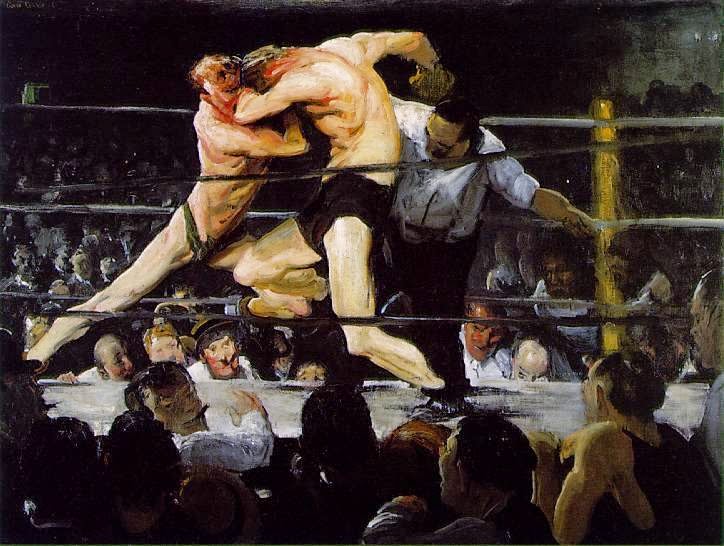
     So often in our society, prizes seem essentially "rigged" beforehand.  Reading the astonishing variety of reactions to the recent Wayweather-Pacquiao championship boxing match, it seems that many fans are disappointed.  Commentators cite the fact that the "take" was already largely calculated before the match began, assuring that both fighters would be so wealthy that the decision would not have much influence on their subsequent lifestyles.  Many fans felt that one or both of the fighters was just going through the motions and failing to deliver a performance worthy of the high price. I would take exception to this, since anyone who has spent even one round in the ring with a trained boxer knows that it can be an experience so grueling that questions of dollars rapidly fade from relevance.  Could a bigger purse, a super-prize, have made them produce what some of the fans wanted?  Perhaps a better question is: might not such a super-prize have been more meaningful if both men had been able to confront each other at the height of their abilities, rather than late in careers that the boxers were making superhuman efforts to maintain and extend, knowing that they were a step behind, a punch slower, than they once were.

     This brings up the fundamental question -- and here we jump back into the future -- of what we really want to use prizes for.   What are the collective goals?  Are great journeys one of them?  Can a great journey into our solar system be one?  Jules Verne's Phileas Fogg, in Around the World in Eighty Days, sets out on his adventure to win a bet that was essentially a financial prize. Henry Stanley crossed Africa in pursuit of Doctor Livingstone, motivated by a prize in the form of a commission. Both were effective in producing desired results, despite hardship.  Both involved considerable risk, as did the ventures of SpaceX and Orbital Sciences.  Elon Musk, father of SpaceX, sees the colonization of Mars much in terms of a prize objective, one the company is already planning for before a prize is offered.  Will he, will we, be willing to go all fifteen rounds until the final bell sounds?  Do we really want to?  These are questions waiting for answers.